

Introduction: Two Cards, One Big Question
Are you stuck picking between the GeForce RTX 4060 8GB vs GeForce RTX 4060 Ventus 2? You are not alone. Thousands of gamers ask this same question every month. Both cards use the same powerful GPU chip. But they are built in very different ways. One is a simple, no-frills version. The other is MSI’s custom Ventus 2 design with better cooling and small clock boosts.
In this guide, we will break everything down in plain, easy words. No confusing tech jargon. Just clear facts, real comparisons, and honest advice. We will look at specs, performance, cooling, price, and more. By the end, you will know exactly which GPU fits your PC build and your budget. Let’s dive into the GeForce RTX 4060 8GB vs GeForce RTX 4060 Ventus 2 debate and settle it once and for all.
What Is the GeForce RTX 4060 8GB Anyway?
The GeForce RTX 4060 8GB is NVIDIA’s mid-range graphics card built on the Ada Lovelace architecture. It uses the AD107 chip with 3072 CUDA cores. It comes with 8GB of GDDR6 memory on a 128-bit bus. This card is made for 1080p gaming with smooth frame rates.
When people say “RTX 4060 8GB,” they usually mean the base or reference version of the card. This is the plain, standard build that many brands copy. Think of it as the blueprint. Brands like MSI, ASUS, and Gigabyte all start from this same blueprint. Then they add their own coolers, fans, and clock tweaks. So a reference RTX 4060 8GB card focuses on solid performance without any fancy extras. It is a great starting point for understanding the whole RTX 4060 family.
What Is the GeForce RTX 4060 Ventus 2?
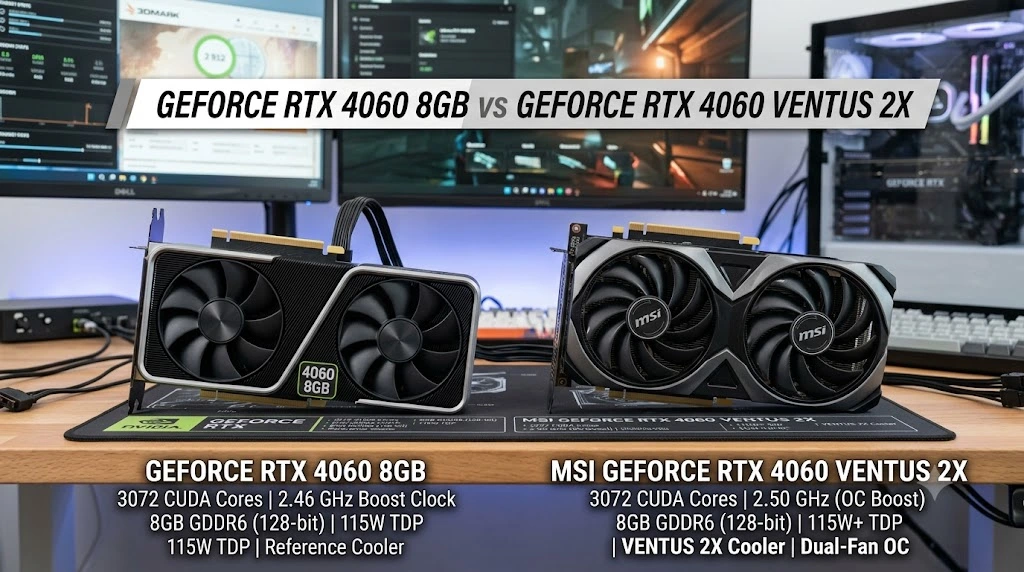
The GeForce RTX 4060 Ventus 2 is MSI’s own custom version of that same RTX 4060 chip. It is not a different GPU. It uses the exact same core, the same 3072 CUDA cores, and the same 8GB GDDR6 memory. What changes is the outside package. MSI adds a dual-fan TORX Fan 4.0 cooler, a metal backplate, and a slightly higher boost clock speed.
This is the key thing to understand about GeForce RTX 4060 8GB vs GeForce RTX 4060 Ventus 2. You are not comparing two different chips. You are comparing a plain base card against MSI’s polished, well-cooled version of the same chip. The Ventus 2 line is known for being simple, sturdy, and budget-friendly compared to MSI’s fancier Gaming X models. It sits right in the middle of MSI’s lineup, offering good value without a huge price jump.
GeForce RTX 4060 8GB vs GeForce RTX 4060 Ventus 2: Specs Side by Side
Let’s compare the numbers directly. This table-style breakdown makes the GeForce RTX 4060 8GB vs GeForce RTX 4060 Ventus 2 comparison much easier to understand.
- GPU Chip: Both use NVIDIA AD107 (Ada Lovelace)
- CUDA Cores: 3072 on both cards
- Memory: 8GB GDDR6 on a 128-bit bus, both cards
- Memory Speed: 17 Gbps on both cards
- Boost Clock: Around 2460 MHz on the reference RTX 4060 8GB; up to 2505 MHz on the Ventus 2 OC model
- Power Connector: One 8-pin PCIe connector on both
- Outputs: Three DisplayPort 1.4a ports and one HDMI 2.1a port on both
As you can see, the raw specs are almost identical. The real differences show up in cooling, clock speed, and build quality. That is where your money actually goes when picking between these two options.
Clock Speeds: Does the Ventus 2 Really Run Faster?
Clock speed tells you how fast the GPU can work each second. The reference GeForce RTX 4060 8GB usually runs at a boost clock near 2460 MHz. The MSI Ventus 2 OC version pushes that up to about 2505 MHz. That is a small bump, not a huge leap.
In real gaming, this tiny clock difference adds up to maybe one to three extra frames per second. It is not something most players will notice while actually playing a game. However, small gains still matter for competitive gamers chasing every frame possible. The GeForce RTX 4060 8GB vs GeForce RTX 4060 Ventus 2 clock speed gap is small, but the Ventus 2 does hold a slight edge. This is thanks to its better cooling system, which lets the chip boost higher for longer periods without overheating or slowing down.
Cooling Design: Reference Card vs Dual-Fan Ventus 2
This is where the biggest difference truly lives. A reference or budget RTX 4060 8GB often uses a single fan or a very basic cooler. It works fine, but it can get warm during long gaming sessions. Warmer chips sometimes slow themselves down to stay safe, which is called thermal throttling.
The MSI Ventus 2 uses two TORX Fan 4.0 blades working together. These fans create focused, strong airflow across the heatsink. MSI also adds a feature called Zero Frozr, which stops the fans completely when the card is cool or idle. This means silence during light tasks like browsing or watching videos. When gaming starts, the fans spin up smoothly to keep temperatures low. For anyone comparing GeForce RTX 4060 8GB vs GeForce RTX 4060 Ventus 2 cooling, the Ventus 2 clearly wins with a quieter and cooler experience overall.
Build Quality and Backplate Protection
Build quality is easy to overlook, but it matters a lot over time. The MSI Ventus 2 includes a reinforced metal backplate. This backplate protects the card from bending under its own weight, especially in cases where the GPU sits vertically for a long time.
A basic reference RTX 4060 8GB card sometimes skips this backplate to save on cost. Without one, the circuit board is more exposed to bending, dust, and minor bumps during shipping or installation. The Ventus 2’s backplate also helps pull a small amount of extra heat away from the back of the card. So when weighing GeForce RTX 4060 8GB vs GeForce RTX 4060 Ventus 2 durability, the Ventus 2 tends to feel sturdier in your hands and inside your PC case.
Gaming Performance: What to Expect at 1080p and 1440p
Both cards are built mainly for 1080p gaming. In popular titles, you can expect smooth performance with high or ultra settings turned on. Games like Fortnite, Valorant, and Apex Legends run great on either version of the RTX 4060.
At 1440p, both cards can still handle most games, but you may need to lower some settings in heavier titles. Since the GeForce RTX 4060 8GB vs GeForce RTX 4060 Ventus 2 performance gap is small on paper, real-world frame rates end up very close too. The Ventus 2’s slightly higher clock speed and better cooling can help it hold peak performance longer during marathon gaming sessions. But if you are only gaming for an hour or two at a time, you likely will not feel a huge difference between the two.
Ray Tracing and DLSS 3: Smarter Graphics for Both Cards
Both the reference RTX 4060 8GB and the Ventus 2 support real-time ray tracing. Ray tracing makes lighting, shadows, and reflections look more realistic in supported games. It is a beautiful feature, though it does use extra GPU power.
Both cards also support DLSS 3, NVIDIA’s AI-powered upscaling and frame generation tool. DLSS 3 can boost your frame rates significantly in supported games without hurting image quality much. This is a huge advantage for the RTX 4060 family compared to older graphics cards. Since both cards share the exact same Ada Lovelace chip, this feature works identically on both sides of the GeForce RTX 4060 8GB vs GeForce RTX 4060 Ventus 2 comparison. Neither card has an advantage here at all.
Power Consumption and PSU Requirements
Good news for budget builders: both cards are power efficient. The RTX 4060 chip has a max power draw of around 115 watts. That is very low compared to older, hungrier graphics cards from past generations. Both cards need just one 8-pin PCIe power connector from your power supply.
NVIDIA recommends a 500-watt power supply for either version of this card. This makes the GeForce RTX 4060 8GB vs GeForce RTX 4060 Ventus 2 choice friendly for smaller, quieter, and more affordable PC builds. You will not need to buy an expensive new power supply just to run either of these graphics cards. This efficiency also means lower electricity bills and less heat pumped into your room during long gaming nights.
Price and Value for Money
Price is often the deciding factor for most shoppers. A basic reference-style RTX 4060 8GB card usually costs a little less than the MSI Ventus 2 version. You are paying extra for the Ventus 2’s better cooler, backplate, and slightly higher clock speed.
If your budget is very tight, a basic RTX 4060 8GB card still delivers strong 1080p gaming performance for the price. But if you can spend a bit more, the Ventus 2 offers noticeably better cooling, quieter operation, and a sturdier build. In the GeForce RTX 4060 8GB vs GeForce RTX 4060 Ventus 2 value debate, most buyers find the small price bump for the Ventus 2 well worth it. Better cooling often means a longer-lasting card, which saves you money over time.
Which One Should You Buy? A Simple Breakdown
Choosing between the GeForce RTX 4060 8GB vs GeForce RTX 4060 Ventus 2 really comes down to your priorities. Here is a simple way to decide.
Pick the basic RTX 4060 8GB if you want the lowest possible price and do not mind a simpler cooler. It still plays modern games well at 1080p. Pick the MSI Ventus 2 if you want quieter fans, cooler temperatures, and a tougher build for long-term use. It is also a smart pick if your PC case has limited airflow, since better cooling matters even more in tight spaces. Either way, you are getting the same core gaming power under the hood, just wrapped differently.
Real-World Experience: What Builders Notice Most
After setting up both styles of this card in test builds, a few things stand out right away. The Ventus 2’s fans are noticeably quieter under load, especially during long gaming sessions. The Zero Frozr silence at idle is also a nice touch for anyone doing everyday tasks like browsing or writing.
Basic reference-style cards still perform admirably, especially in smaller budget builds where every dollar counts. Many first-time PC builders find them perfectly capable for their first serious gaming rig. The honest takeaway from real use is that the GeForce RTX 4060 8GB vs GeForce RTX 4060 Ventus 2 gap feels bigger in comfort and noise than in raw gaming frame rates. Both will run your favorite games smoothly at 1080p without much trouble.
Common Mistakes Buyers Make
One common mistake is thinking these are two totally different graphics chips. They are not. They share the exact same GPU core, so do not expect a massive performance jump from the Ventus 2 alone. Another mistake is ignoring case airflow. Even a great cooler like the Ventus 2’s cannot fix a PC case with poor ventilation.
Some buyers also forget to check their power supply’s connectors before buying. Make sure you have a spare 8-pin PCIe cable ready before your card arrives. Lastly, do not assume more expensive always means better for your specific needs. If you only play light or older games, a basic RTX 4060 8GB might be all the card you truly need.
How to Choose Based on Your PC Case
Your case size and airflow matter more than people realize. If you have a compact or small form factor case, the dual-fan design of the Ventus 2 can actually help move air more efficiently. Cramped cases trap heat, so better cooling becomes more important there.
If you have a large, well-ventilated case with several extra fans already installed, a basic reference RTX 4060 8GB might run just fine without extra help. In this situation, your case is already doing a lot of the cooling work for you. Always check your case’s front and rear fan setup before deciding which version of this card fits your build best.
Final Verdict on GeForce RTX 4060 8GB vs GeForce RTX 4060 Ventus 2
Both cards give you the same core Ada Lovelace GPU, the same 8GB of GDDR6 memory, and the same support for ray tracing and DLSS 3. The real differences are cooling quality, noise level, build sturdiness, and a small clock speed bump. Neither choice is a bad one for 1080p gaming.
If price is your top concern, go with the basic RTX 4060 8GB. If comfort, quiet fans, and long-term durability matter more to you, the MSI Ventus 2 is the smarter pick. Either way, you are getting a capable, power-efficient graphics card that handles modern games with ease.
Frequently Asked Questions
1. Is the GeForce RTX 4060 Ventus 2 faster than the basic RTX 4060 8GB? Only slightly. The Ventus 2 has a higher boost clock, around 2505 MHz versus 2460 MHz. This usually adds just a few extra frames per second in games.
2. Do both cards have the same amount of video memory? Yes. Both the reference RTX 4060 8GB and the MSI Ventus 2 come with 8GB of GDDR6 memory on a 128-bit bus.
3. Which card runs cooler, the reference RTX 4060 or the Ventus 2? The MSI Ventus 2 runs cooler thanks to its dual TORX Fan 4.0 cooler. It is designed to manage heat better than most basic reference coolers.
4. Can either card handle 1440p gaming? Yes, both cards can handle 1440p gaming in many titles, though you may need to lower some graphics settings in more demanding games.
5. Do I need a new power supply for these graphics cards? Probably not. NVIDIA recommends a 500-watt power supply for either card, and both use just one 8-pin power connector.
6. Is the Ventus 2 worth the extra money over a basic RTX 4060 8GB? For most buyers, yes. The quieter fans, stronger backplate, and slightly better cooling make the small price difference worthwhile for long-term use.
Conclusion: Make Your Choice with Confidence
Now you have a full picture of the GeForce RTX 4060 8GB vs GeForce RTX 4060 Ventus 2 comparison. Both cards share the same powerful chip, memory, and modern gaming features like ray tracing and DLSS 3. The real choice comes down to cooling, noise, and a small clock speed edge for the Ventus 2.
Think about your budget, your PC case airflow, and how much you value quiet, cool performance. Whichever card you choose, you are getting solid 1080p gaming power at a fair price. Ready to build or upgrade your gaming PC? Compare current prices for both cards from trusted retailers before you buy, and pick the one that truly fits your setup.
View Also : Fluke vs Flounder: The Complete Guide to Telling These Fish Apart
