

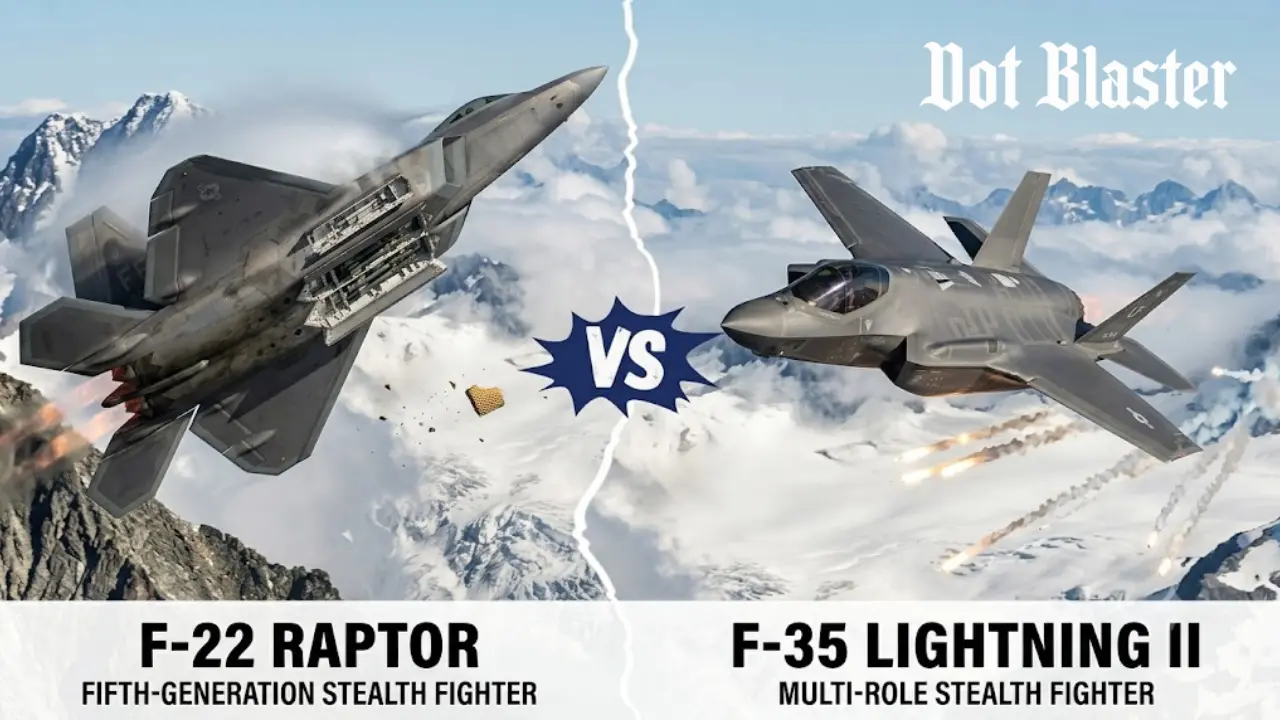
Have you ever looked up at the sky and wondered what the world’s best fighter jets can do? Two planes always come up in that conversation. They are the F-35 Lightning II and the F-22 Raptor. People often search “Joint Strike Fighter vs F 22 Raptor” because both jets are stealthy, both are American, and both cost a fortune. But they are built for very different jobs.
In this guide, we will break down every part of the Joint Strike Fighter vs F 22 Raptor debate. We will talk about speed, stealth, weapons, cost, and combat roles. We will use simple words and short sentences, so anyone can follow along. By the end, you will know exactly why the military needs both jets, not just one. Let’s dive right in.
What Is the Joint Strike Fighter Program?
The Joint Strike Fighter program started in the 1990s. Its goal was simple. The U.S. military wanted one aircraft that could do many jobs. Before this program, the Air Force, Navy, and Marines each used different jets. That got expensive fast. So the government asked companies to design one flexible fighter.
Lockheed Martin won this contract in 2001. Its design became the F-35 Lightning II. This jet had to fly for the Air Force, land on Navy carriers, and even take off vertically for the Marines. That is a huge challenge for one airframe. Many NATO countries joined the program too. They helped pay for development and later bought their own F-35 jets. Today, more than fifteen countries fly this aircraft. This is why the Joint Strike Fighter vs F 22 Raptor comparison always starts with one key fact. The F-35 was built to be shared, while the F-22 was built to stay exclusive.
Meet the F-22 Raptor: America’s Air Superiority King
The F-22 Raptor came from a different program called the Advanced Tactical Fighter, or ATF. This project began during the Cold War. The goal was to build a jet that could beat any Soviet fighter in the sky. Lockheed Martin won this contract too, back in 1991.
The Raptor entered service in 2005. It was designed for one main mission: air-to-air combat. It needed to fly fast, turn sharp, and stay hidden from enemy radar. Engineers gave it powerful engines and a sleek, stealthy shape. The result was a jet that could outfly almost anything else in the sky. However, the F-22 never went into full mass production. The original plan called for 750 aircraft. Budget cuts and a changing world after the Cold War shrank that number to under 200. This scarcity makes the Raptor one of the rarest and most guarded fighter jets on Earth. In fact, the U.S. still will not export it to any other country.
Joint Strike Fighter vs F 22 Raptor: The Core Difference Explained
Here is the simplest way to understand the Joint Strike Fighter vs F 22 Raptor question. The F-22 is a specialist. The F-35 is a generalist. Think of it like two athletes. One is a sprinter built for one event. The other is a decathlete trained for ten different events.
The F-22 focuses on winning dogfights and controlling the skies. It clears the way so other planes can operate safely. The F-35, on the other hand, handles bombing runs, spying missions, electronic jamming, and close support for troops on the ground. It also shares data with other jets, ships, and soldiers in real time. This teamwork ability makes the F-35 more like a flying computer than just a fighter. So when people compare the Joint Strike Fighter vs F 22 Raptor, they are really comparing raw dogfighting power against smart, connected versatility. Both approaches matter in modern warfare, and neither jet was designed to fully replace the other.
Speed and Performance: Which Jet Flies Faster?
Speed is where the F-22 truly shines. The Raptor can reach speeds close to Mach 2.25. That means it flies over twice the speed of sound. Even better, it can “supercruise.” This lets it fly at supersonic speeds without using extra fuel-hungry afterburners. Few jets in the world can do that.
The F-35 is slower by comparison. Its top speed sits around Mach 1.6. That is still very fast, but it cannot supercruise like the Raptor. The F-35 also has a lower service ceiling, meaning it cannot fly quite as high. The Raptor can climb near 65,000 feet, while the F-35 tops out closer to 49,000 feet. If speed and altitude were the only things that mattered, the F-22 would win easily. But real air combat depends on more than just raw numbers. Sensors, weapons, and teamwork often matter just as much as top speed in today’s fights.
Stealth Technology: Which Jet Hides Better From Radar?
Both jets use stealth shaping, special coatings, and internal weapons bays to stay hidden. This is a big part of why the Joint Strike Fighter vs F 22 Raptor debate gets so heated among aviation fans. Most experts agree the F-22 has a slightly smaller radar signature overall. Its shape was designed purely for air combat stealth, with very aggressive angles.
The F-35 was engineered a bit differently. Its stealth focuses heavily on hiding from ground-based radar systems, like the ones used by surface-to-air missile batteries. This makes the F-35 excellent at sneaking past enemy air defenses to strike ground targets. So while the F-22 might be slightly stealthier in the air, the F-35 is arguably better tuned for surviving over hostile territory. Neither jet is invisible, but both are far harder to detect than older fighters like the F-15 or F-16. This stealth gap is one reason both aircraft remain so valuable today.
Weapons and Firepower Comparison
When people ask about the Joint Strike Fighter vs F 22 Raptor, weapons always come up. The F-22 carries a focused air-to-air loadout. It typically holds six AIM-120 AMRAAM missiles for long-range shots and two AIM-9X Sidewinders for close combat. All of these fit inside its body to protect its stealth. It can also carry a couple of small guided bombs, but ground attack is not its main job.
The F-35 carries a much wider variety of weapons. It can drop laser-guided bombs, launch anti-ship missiles, and fire long-range cruise missiles. It can also carry weapons on external hardpoints when stealth is not needed, giving pilots more firepower for less risky missions. This flexibility is a huge advantage for ground attack and strike missions. So while the F-22 wins in pure air-to-air weapon focus, the F-35 wins by a wide margin in overall weapon variety and mission flexibility.
Cost and Production Numbers
Money matters a lot in military planning. The F-22 Raptor costs roughly 150 million dollars per aircraft. Because production stopped years ago, only around 195 units were ever built. That scarcity makes every single Raptor extremely valuable and hard to replace if lost.
The F-35 costs less per unit, closer to 85 million dollars depending on the version. Because it is still in active production, the numbers tell a very different story. Over 1,000 F-35 jets have already been delivered worldwide, with plans for thousands more. This is one of the clearest differences in the entire Joint Strike Fighter vs F 22 Raptor discussion. The F-35 was built to be affordable enough for mass production and export sales. The F-22 was built as a premium, limited asset kept only for U.S. forces. Lower cost and higher output give the F-35 a major logistical advantage over time.
Range and Combat Radius
Range decides how far a jet can fly before it needs fuel. The F-22 Raptor has a slight edge here too, with a range close to 3,000 kilometers. Its powerful engines were built for long, fast intercept missions over huge stretches of sky, which matters for defending large territories.
The F-35 comes in a bit shorter, with a range near 2,800 kilometers. That gap is small, though, and pilots can extend both jets using aerial refueling tankers. In real missions, refueling support usually matters more than a small difference in base range. Both aircraft were designed with enough fuel capacity to strike deep into contested airspace and return safely. So while the F-22 technically flies farther on paper, this difference rarely changes real-world mission planning in any major way.
Sensor Fusion: The F-35’s Secret Weapon
If there is one area where the F-35 clearly dominates, it is sensor fusion. This is where the Joint Strike Fighter vs F 22 Raptor comparison really shifts. The F-35 combines data from radar, infrared cameras, and other aircraft into one simple picture for the pilot. Instead of juggling multiple screens, the pilot sees everything in one clear display.
This system also lets the F-35 share information instantly with other jets, ships, and ground troops. It acts like a flying quarterback, directing the whole battlefield picture. The F-22 has strong sensors too, but it was built before this level of networking became standard. Retrofits have improved its data-sharing over the years, but it still cannot match the F-35’s built-in fusion technology. This is why many experts call the F-35 more of an “information platform” than a traditional fighter jet. That difference changes how modern militaries plan entire missions.
Combat Roles: How Each Jet Is Actually Used
The F-22 Raptor mainly patrols the skies, hunts enemy aircraft, and protects other jets during high-risk missions. It goes in first to clear the way, using its speed and stealth to dominate any airborne threat before anyone else even arrives. This is called achieving air superiority.
The F-35 handles a much broader mission list. It strikes ground targets, gathers intelligence, jams enemy signals, and supports troops fighting on the ground. It can also work from aircraft carriers and short runways, depending on the version. Interestingly, despite its fearsome reputation, the F-22 has never shot down an enemy aircraft in real combat. Its role has mostly been deterrence and training exercises. The F-35, meanwhile, has already seen real combat strikes in several conflicts. This shows how the Joint Strike Fighter vs F 22 Raptor roles play out very differently once the jets actually leave the hangar.
Which Countries Fly the F-35 and F-22?
Export rules create a massive difference here. The United States has never sold the F-22 Raptor to any other country. Strict laws protect its advanced technology from ever leaving American hands. Every single Raptor belongs only to the U.S. Air Force, and that will likely never change.
The F-35 tells a completely different story. Countries like the United Kingdom, Australia, Japan, Israel, and many NATO nations fly their own F-35 fleets. This wide distribution strengthens alliances and allows allied forces to train and fight together using shared technology. It also helps spread out the massive cost of the program across many nations. This global reach is a major reason the F-35 has become the backbone of Western airpower, while the F-22 remains a rare, closely guarded American exclusive.
What Comes After the F-22 Raptor?
The F-22 is getting older, and the Pentagon knows it. In 2025, the Air Force awarded a contract to Boeing for a brand-new jet called the F-47. This aircraft belongs to a new generation known as sixth-generation fighters. It is meant to eventually take over the Raptor’s air superiority role.
This announcement raised a big question among defense experts. Did America build the right number of stealth jets at the right time? Some argue the F-22 fleet was cut too short decades ago. Others say the F-35’s mass production made up for that gap by flooding allied skies with capable stealth fighters. Either way, the future clearly points toward newer designs eventually joining both the F-35 and F-22 in service. For now, though, these two jets remain the most advanced stealth fighters actively flying combat missions today.
Joint Strike Fighter vs F 22 Raptor: Which One Would Win in a Dogfight?
This is the question everyone really wants answered. In a pure, close-range dogfight, most experts believe the F-22 would win. Its speed, agility, and thrust-vectoring engines let it out-turn and outrun almost anything, including the F-35. Its stealth was also purpose-built for exactly this kind of fight.
However, real air combat rarely looks like old movie dogfights anymore. Most modern battles happen beyond visual range, using radar and missiles fired from miles away. In that kind of fight, the F-35’s superior sensors and networking could spot an enemy first and strike before the enemy even knows it is there. So the honest answer to the Joint Strike Fighter vs F 22 Raptor rivalry is this: the F-22 likely wins a close turning fight, but the F-35 might win the smarter, longer-range battle. It truly depends on how the fight unfolds.
Why the Military Needs Both Jets
Some people assume one jet should simply replace the other. That idea misunderstands how modern airpower actually works. The F-22 and F-35 are meant to work together as a team, not compete against each other for the same job.
Picture a real mission. F-22 Raptors fly ahead, clearing the skies of any enemy fighters using their speed and stealth. Once the airspace is safer, F-35 jets move in to strike ground targets, gather intelligence, and support troops below. Each jet covers the other’s weaknesses. The F-22 lacks strike versatility, while the F-35 lacks top-end speed and agility. Together, though, they create a complete air combat package. This teamwork approach is exactly why understanding the Joint Strike Fighter vs F 22 Raptor relationship matters so much for anyone studying modern military strategy today.
Final Thoughts: Two Legends, One Shared Mission
After digging through all these details, one thing becomes clear. The Joint Strike Fighter vs F 22 Raptor debate is not really about picking a winner. It is about understanding two very different tools built for two very different jobs. The F-22 remains the fastest, stealthiest dogfighter America has ever built. The F-35 remains the smartest, most connected multirole fighter flying today.
Both jets represent incredible feats of engineering, and both continue shaping how modern militaries plan their missions. If you found this breakdown helpful, consider sharing it with a friend who loves aviation as much as you do. Feel free to explore more of our fighter jet comparisons, and drop a comment below telling us which jet you would want to fly if you had the chance. The skies are only getting more advanced from here, so stay curious and keep learning.
Frequently Asked Questions
1. What is the main difference in the Joint Strike Fighter vs F 22 Raptor comparison? The F-22 Raptor is built for air-to-air combat and controlling the skies. The F-35, born from the Joint Strike Fighter program, is built for many roles, including ground strikes, spying, and teamwork with other forces.
2. Which jet is faster, the F-35 or the F-22? The F-22 Raptor is faster. It can reach about Mach 2.25, while the F-35 tops out around Mach 1.6. The Raptor can also supercruise, flying at supersonic speed without afterburners.
3. Why did the U.S. stop building more F-22 Raptors? Budget cuts and changing military priorities after the Cold War ended production early. Only around 195 Raptors were ever built, far fewer than the original plan of 750 aircraft.
4. Can other countries buy the F-22 Raptor? No. The United States has never exported the F-22 Raptor to any other nation. It remains exclusive to the U.S. Air Force due to strict technology protection laws.
5. Is the F-35 stealthier than the F-22? Not quite. Most experts believe the F-22 has a slightly smaller radar signature. However, the F-35’s stealth design is especially effective against ground-based radar and missile systems.
6. Which jet is better for modern combat missions? It depends on the mission. The F-22 excels at winning dogfights and controlling airspace. The F-35 excels at ground strikes, intelligence gathering, and sharing data across the battlefield in real time.
View Also : Racquet vs Squash: Which Racket Sport Is Right for You?
